
UK vs EU Prep Centers: Which Setup Fits Your Amazon Business?
Navigating the post-Brexit logistics landscape: Costs, lead times, and why the UK remains the strategic "Landing Pad" for international sellers.
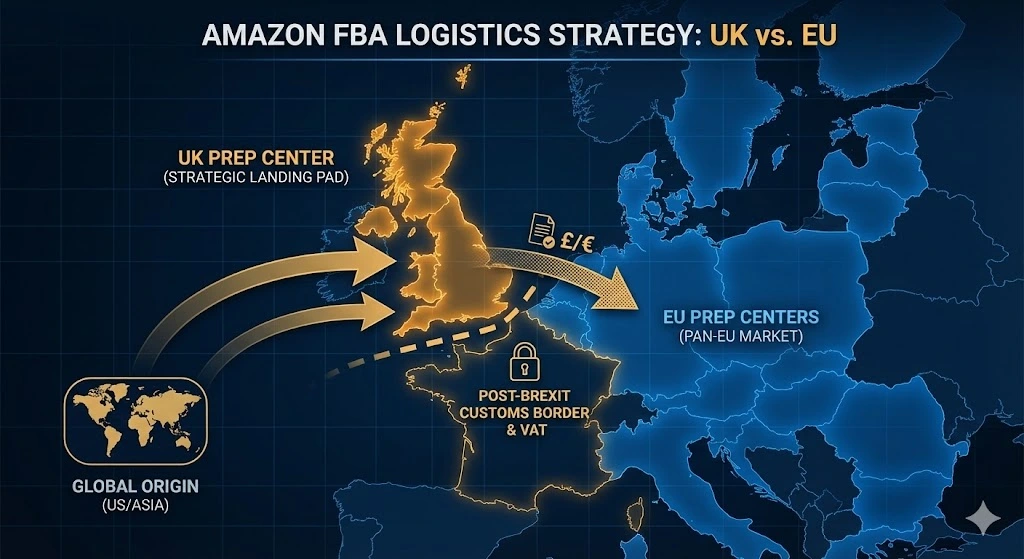
Before Brexit, many sellers treated the UK and EU as a more unified fulfilment landscape. Today, UK–EU inventory moves require customs and create extra VAT and fee considerations. This forces sellers to ask: "Where should I place my inventory?"
Official guidance: UK EORI guidance, UK export declarations, and EU Customs Trader Portal.
Why the UK is Still the Best First Step
Despite the borders, many international sellers still start with the UK because it’s operationally simple, English-first, and a strong standalone marketplace. Here is why the UK prep model often wins for the initial setup.
1. Language & Communication (No Barrier)
Logistics is complex enough without a language barrier. The UK has a high level of English proficiency, which eliminates potential misunderstandings with your prep center.
When things go wrong (and in logistics, they eventually do), working across different languages and time zones can slow down issue resolution. Being able to communicate fluently with your UK-based account manager simplifies this process significantly.
2. The "Fortress UK" Market Size
The UK is one of Amazon’s largest marketplaces and the biggest English-speaking market in Europe. For many sellers, it represents a massive portion of their potential European revenue.
By using a UK prep center, you are optimizing for your biggest profit center first. UK prep centers have a deep understanding of this specific market and consumer behavior, ensuring your goods meet local expectations perfectly.
3. Strategic Global Links
The UK is strategically positioned with established transport links. Ports like Felixstowe and Southampton are massive global hubs, often offering competitive sea freight rates from China. This makes the UK an economical "Landing Pad" to inspect and prep goods before they travel further.
The "Hybrid" Strategy: UK vs. EU
Should you use a prep center in the UK or on the continent? Amazon offers cross-border fulfilment options (e.g., EFN / international fulfilment settings), but post-Brexit shipments between UK and EU involve customs steps and added complexity.
Amazon references: International sales (FBA cross-border) and UK–EU cross-border selling FAQ.
| Feature | UK Prep Center | EU Prep Center |
|---|---|---|
| Primary Market | Best for UK Focus (High Volume) | Best for Pan-EU Focus (DE/FR/IT/ES) |
| Language | Native English (Easy Comms) | Varied (English often 2nd language) |
| Customs Friction | Zero for UK sales. Requires customs to ship to EU. | Zero for EU sales. Requires customs to ship to UK. |
| Speed (Inbound) | 24-48h to UK FCs | 24-48h to EU FCs |
| VAT Complexity | UK VAT Only (Simpler start) | Requires local VAT where stock is held; OSS for cross-border |
Note: VAT and customs obligations depend on where goods are stored and where they’re sold.
Handling Compliance & VAT
One major fear for international sellers is compliance. Regulations in Europe differ significantly from the US or Asia.
UK prep centers are well-versed in European regulatory compliance. Furthermore, regarding tax: If you store inventory in EU countries (e.g., Pan-EU/stock placement), you may need local VAT registrations. OSS mainly simplifies certain B2C distance sales VAT reporting.
EU VAT reference: Guide to the VAT One Stop Shop (OSS).
The Verdict: Which One Do You Need?
Choose a UK Prep Center If:
- The UK is your primary or first expansion target (highest ROI).
- You want seamless communication in English.
- You want to verify stock quality before it gets complicated in EU customs.
- You want to test EU demand first, then place inventory into the EU when the numbers justify it.
Choose an EU Prep Center If:
- You have abandoned the UK market entirely.
- Your sales in Germany are significantly higher than in the UK.
- You are importing strictly for the EU Zone and want to bypass the UK.
Pro Tip: Most successful 7-figure sellers eventually use both. But they almost always start with the UK due to the ease of doing business and the sheer size of the English-speaking market.
Ready to conquer the UK Market?
Start with a partner who speaks your language and knows the territory.
Or check our pricing calculator to see the costs.